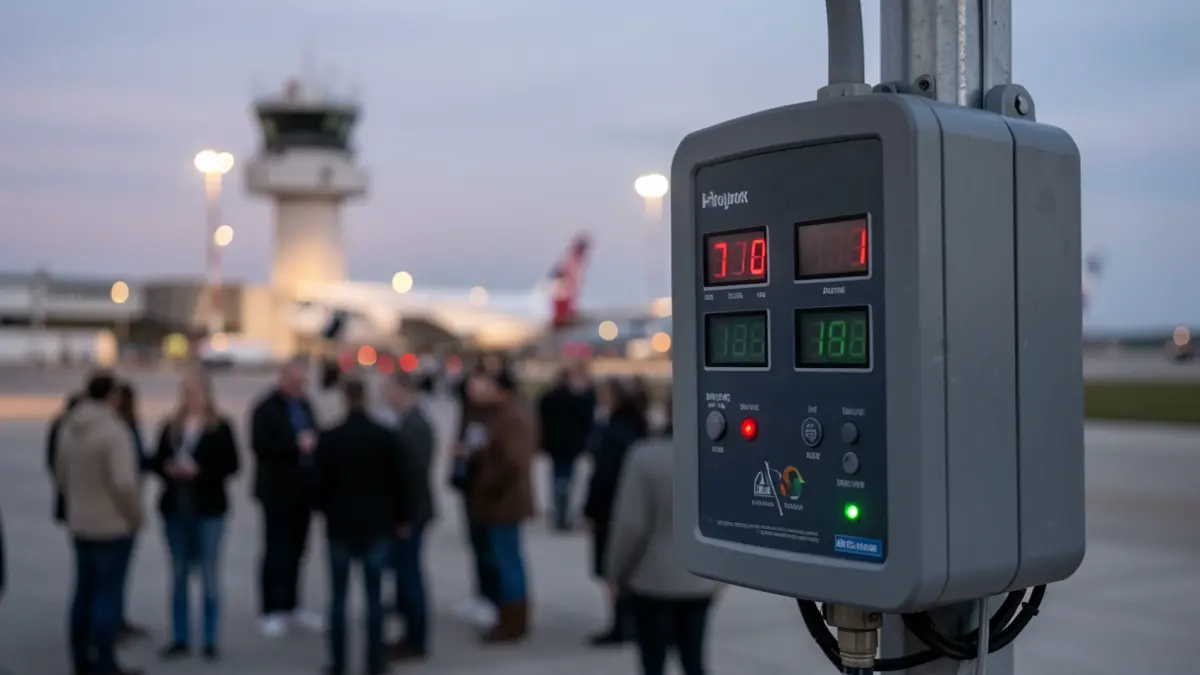
An air quality measurement campaign, carried out from August 29 to November 3, 2025, at Bordeaux-Mérignac Airport, aimed to better understand the influence of air traffic on the concentration of fine and ultrafine particles. The findings were published on November 4, 2026.
A mobile station installed approximately 400 meters from the runway continuously measured particles with diameters ranging from 10 nanometers to 1 micrometer, as well as PM10 and PM2.5 concentrations. Ultrafine particles (UFPs), less than 100 nanometers in diameter, are receiving increasing attention due to associated health concerns.
At the airport site, the average number of particles measured reached 18,553 particles per cm³, significantly higher than the 6,962 at Talence and 6,910 at Poitiers-Augouard, which are urban background sites. PM10 (16.7 µg/m³) and PM2.5 (7.0 µg/m³) concentrations were comparable to those observed in the Bordeaux urban area, where road traffic and residential heating are predominant.
The study observed a link between takeoffs and landings on runway 23 and particle peaks, particularly when winds blew from the west or southwest. However, meteorological conditions and other urban pollution sources also play a significant role.
This exploratory campaign, conducted at a single site over two months, provides an initial dataset for Bordeaux Airport. Further studies at multiple locations and over a longer period are needed to deepen the understanding of air traffic's influence on air particles.