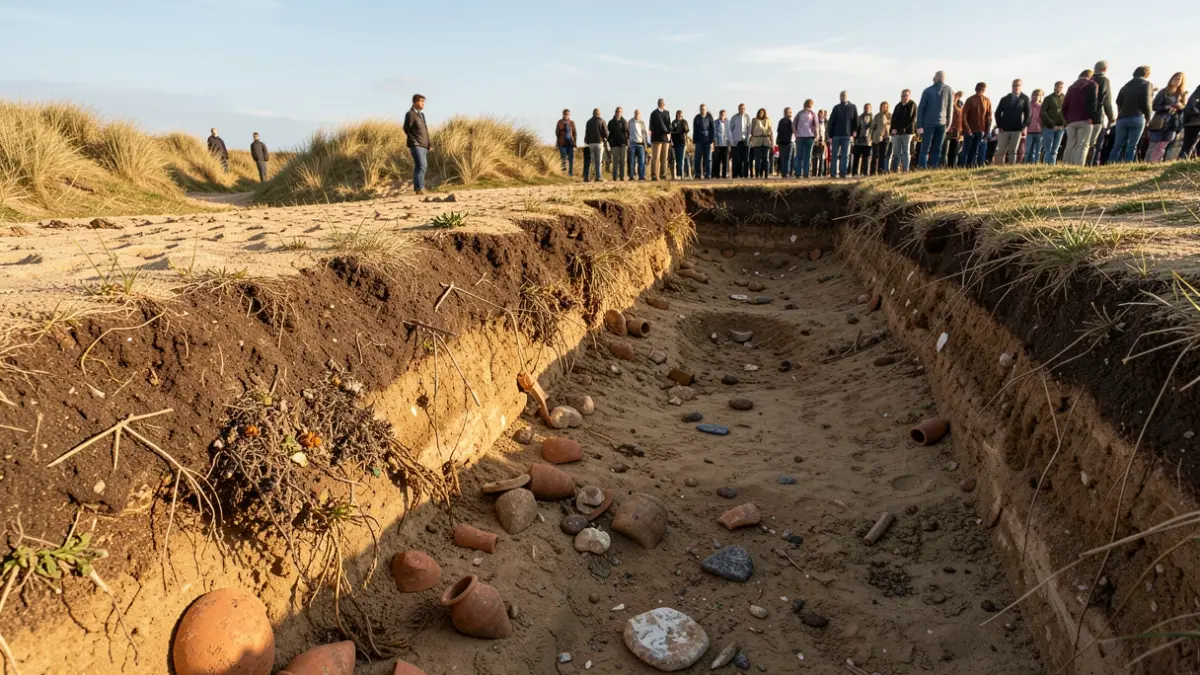
Set up on September 21st at the Grand Site de la Dune du Pilat, the archaeological excavation campaign concluded on Friday, October 9th. Teams from the Réserve ornithologique du Teich and the Maison de la Nature du Bassin d’Arcachon, part of the Parc naturel régional des Landes de Gascogne, were invited to visit the site before its closure, accompanied by archaeologist Philippe Jacques.
Since 2005, excavation campaigns have been conducted every two years to counteract coastal erosion and preserve the history of early human settlements on the Aquitaine coast. The Dune du Pilat is composed of various strata, known as 'paleosols', representing ancient forests that stabilized mobile dunes before being covered by new ones. These dark layers consist of vegetation remains and ancient soils.
Paleosol n°1, at the dune's base, dates back to the late Prehistory (-8000 to -2000 BCE) and indicates the presence of Scots pines, oaks, hazels, birches, and alders. Paleosol n°2 yielded artifacts characteristic of the Early Iron Age. Paleosol n°3, from the late 15th to early 18th century, uncovered about forty archaeological sites linked to artisanal activities like resin distillation. Paleosol n°4, more recent, contains tree stumps and fragments of resin pots used for tapping.
This autumn's excavation focused on forest paleosol n°2 (late Bronze Age to early Second Iron Age, -1000 to -500 BCE). The landscape at that time featured a forest on nearly flat sandy soil, interspersed with clearings and small freshwater ponds. Remains of wooden dwellings and salt-making sites were found within these clearings, suggesting a life based on livestock farming and salt production, as well as wool spinning, fishing, and trade.
The campaign's objective was to pinpoint the location of early wetland areas before they were covered by dune sands. The studied zone, excavated over a hundred meters, aims to define the boundaries of the Pr13 salt-making site and its connection to a pond discovered in 2024. The wood found in the peat filling this pond is exceptionally well-preserved.
“"Thank you for your availability and the quality of your explanations!"