
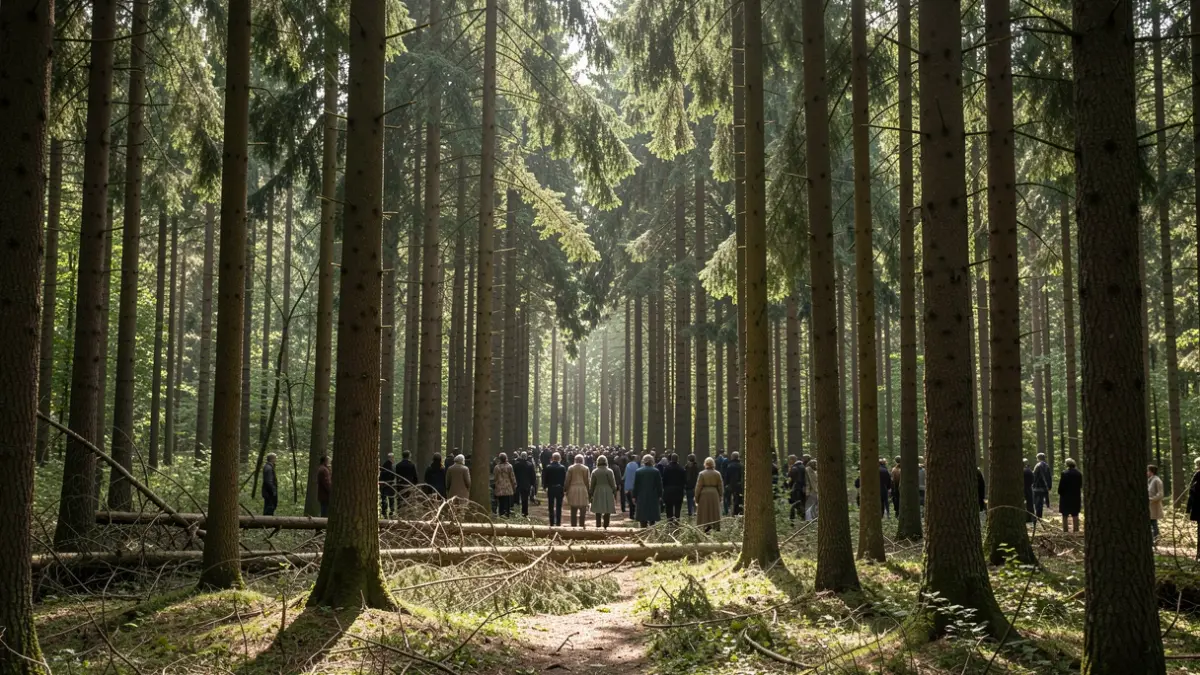
Storms pose a major destructive risk to forests. Traditionally, private forest owners relied on historical trends to assess storm probability and determine optimal felling ages. However, in the context of climate change, this extrapolation is becoming hazardous due to multiple evolving scenarios and uncertainty about future storm frequency and intensity.
Climate change is certain, but its manifestations, like storms, remain unpredictable. To guide decisions in this uncertain environment, economists speak of ambiguity when event probabilities are not perfectly known. A new interdisciplinary approach, combining forest economics, experimental economics, and mathematical modeling, aims to understand how owners react to this ambiguity and risk aversion.
"Our study shows that risk, particularly from storms, encourages forest owners to reduce the age at which they value their trees," explains Stéphane Couture, a researcher at INRAE. A forest owner strongly averse to risk and climate ambiguity tends to cut trees earlier. However, a stronger aversion to ambiguity regarding storm frequency does not significantly alter felling age, as the gain from information is often minimal.
To promote more resilient and economically rational forest management, public policies should prioritize reducing uncertainties. This includes funding localized climate information, developing forest monitoring systems, and producing vulnerability maps. Clarifying risks will foster practices beneficial to ecosystem health.