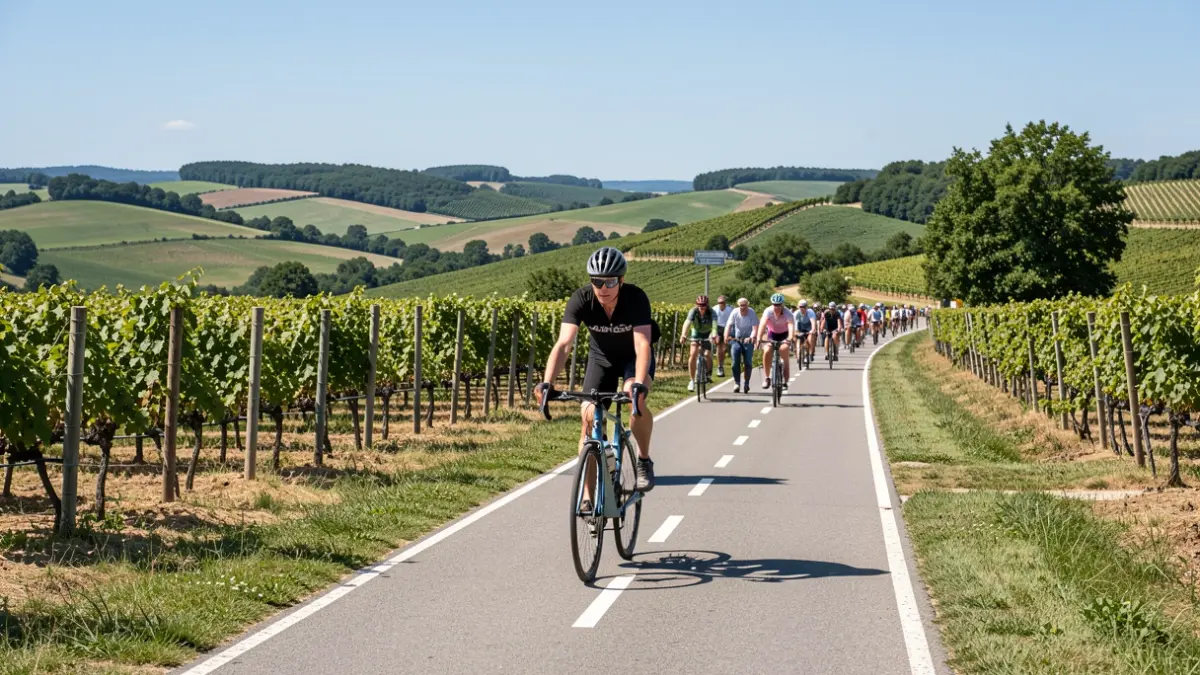
On the occasion of the plenary session on Monday, October 5, the Department adopted a Cycling Infrastructure Charter. This initiative aims to provide a common framework for the design and implementation of cycling infrastructure in the region, thereby strengthening the ambition to make cycling an essential mobility solution for daily life, leisure, and tourism.
In Dordogne, this ambition takes on particular significance. As a rural and multipolar territory, the department experiences numerous journeys between peripheral towns and major life centers. Individual car use remains high, even though a significant portion of trips are over short distances: 55% of trips are less than 5 km and 60% are between 1 and 3 km in rural areas. The development of cycling is therefore a major issue for mobility, ecological transition, quality of life, and territorial attractiveness. It addresses concrete needs such as connecting town centers to public facilities, schools, train stations, and employment zones, while facilitating residents' travel and enhancing the tourism offer.
The charter aligns with the Departmental Scheme for Sustainable Mobility and complements the Departmental Plan for Cycle Routes and Greenways. Its simple principle is that cycling infrastructure only makes sense if it is part of a coherent network. The goal is no longer just to create kilometers of paths or greenways, but to build continuous, legible, safe, comfortable, and use-adapted routes. The structuring principles include connecting life and activity hubs, prioritizing routes, ensuring route continuity, adapting the level of separation between traffic flows to the context, and guaranteeing comfort, legibility, and safety.
This policy extends beyond just cycling, fully participating in territorial development. Moving better also means living better, connecting territories more effectively, and strengthening their attractiveness. Cycling practice thus serves as a lever for daily mobility, as well as for tourism, local commerce, access to services, and the enhancement of the Périgord landscape and heritage.
The Cycling Infrastructure Charter is intended as a toolkit to facilitate projects for municipalities, intercommunalities, and project managers. It provides common benchmarks, methods, and concrete solutions to accelerate the transition from idea to project. It gathers technical and methodological recommendations adapted to the territory's realities, helping to define needs, choose routes, manage continuity, organize signage and wayfinding, consider land and environmental constraints, and identify available funding.
The Department offers its engineering expertise to local authorities, providing support for the analysis, design, and implementation of cycling projects. Its services, including the Engineering Pole, road and bridge departments, the Departmental Technical Agency, as well as experts in landscape, tourism, and mobility, aim to secure technical choices, anticipate constraints, and improve the quality and financing of projects.
The charter establishes a common foundation while allowing local actors to adapt their projects to their specific realities. The Department does not replace municipalities and intercommunalities; it empowers them to succeed through enhanced cooperation. It also helps identify funding mechanisms, potentially combining departmental, regional, national, or European aid, with departmental support potentially reaching up to 15% of the project cost.
Finally, the charter includes technical sheets and tools to foster a shared cycling culture in Dordogne. The Department emphasizes that infrastructure alone is insufficient, and that cycling services, communication, training, and awareness are essential complementary levers for sustainable practice development.
During the plenary session, presentations were made on the departmental committee for citizenship and autonomy, the activity report of the Dordogne-Périgord Cultural Agency, and the new calculation method for college operating grants. The territorial integration pact for the period 2026-2030 was adopted to strengthen the integration policy for RSA beneficiaries. An advance of €3.2 million was voted for the SDIS 24.