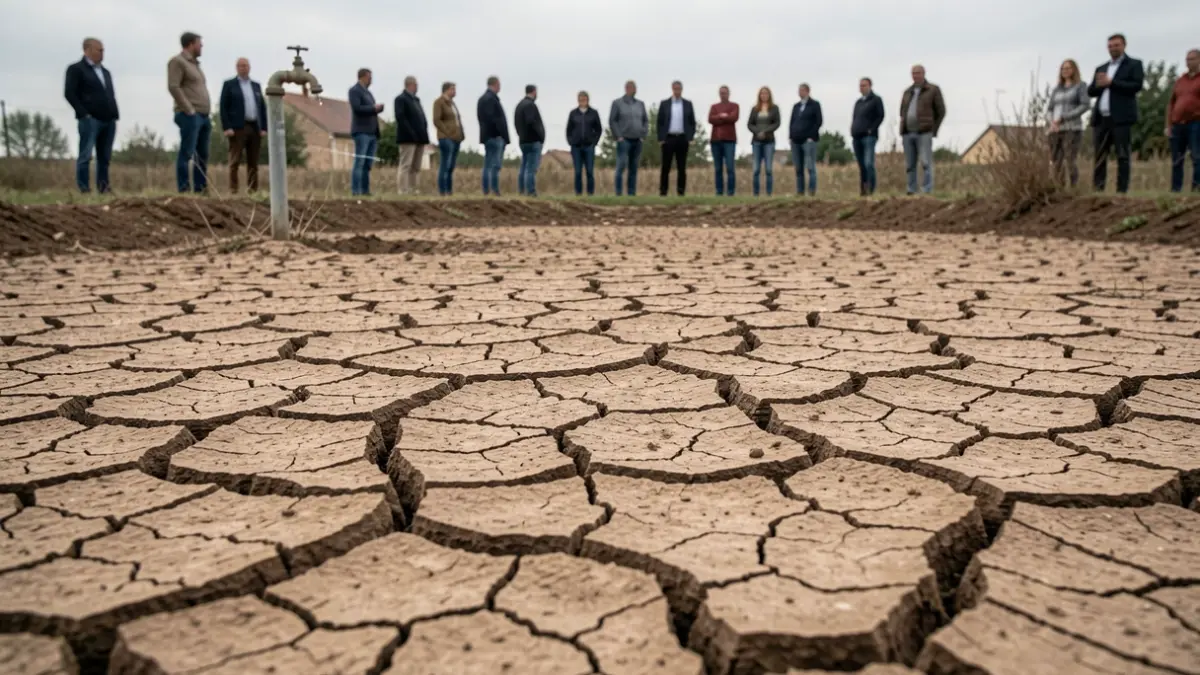
Summer 2026 was marked by intense heat in Grand Périgueux, with 77 days above 30 degrees Celsius and 20 nights above 20 degrees Celsius between May and September. Faced with this situation, the need to adapt water management has become paramount.
Stéphane Dobbels, Delegate Councilor for the integrated water cycle at Grand Périgueux, emphasizes that integrated stormwater management should not be seen as a constraint. On the contrary, it represents an opportunity to design more resilient, attractive territories adapted to climate change.
Beyond water-related issues, other consequences of climate change, such as clay swelling and shrinkage, also affect the region. Michel Benard, a specialist in integrated stormwater management, presented existing experiences and projects, highlighting solutions like vegetated swales, landscaped infiltration basins, and the greening of public spaces to help lower urban temperatures.
The four main principles of Integrated Stormwater Management are: managing water where it falls, reducing the volume and flow rates discharged into networks and natural environments, integrating water into the city, and controlling territorial flooding.
Several territories shared their experiences. In Boulazac-Isle-Manoire, Mayor Fanny Castaignede detailed three school projects where greening, cooling, and landscaping with drought-resistant plants allowed for natural rainwater infiltration, even during recent heavy rainfall (50 mm). She stressed the duty of elected officials to anticipate the future.
In Abjat sur Bandiat, Deputy Mayor Hubert Paulhiac mentioned that the redevelopment of the village, with the planting of over 100 different plant species, has improved the living environment and pedestrian experience, contributing to the establishment of new businesses and village life. A project to de-impermeabilize a public square is being considered.
Guillaume Krabal, Vice-President of La Rochelle agglomération in charge of the small water cycle, highlighted the importance of collective commitment in addressing residents' concerns. Information meetings have helped convince many citizens of the benefits of this management approach, particularly in providing coolness during heatwave periods.