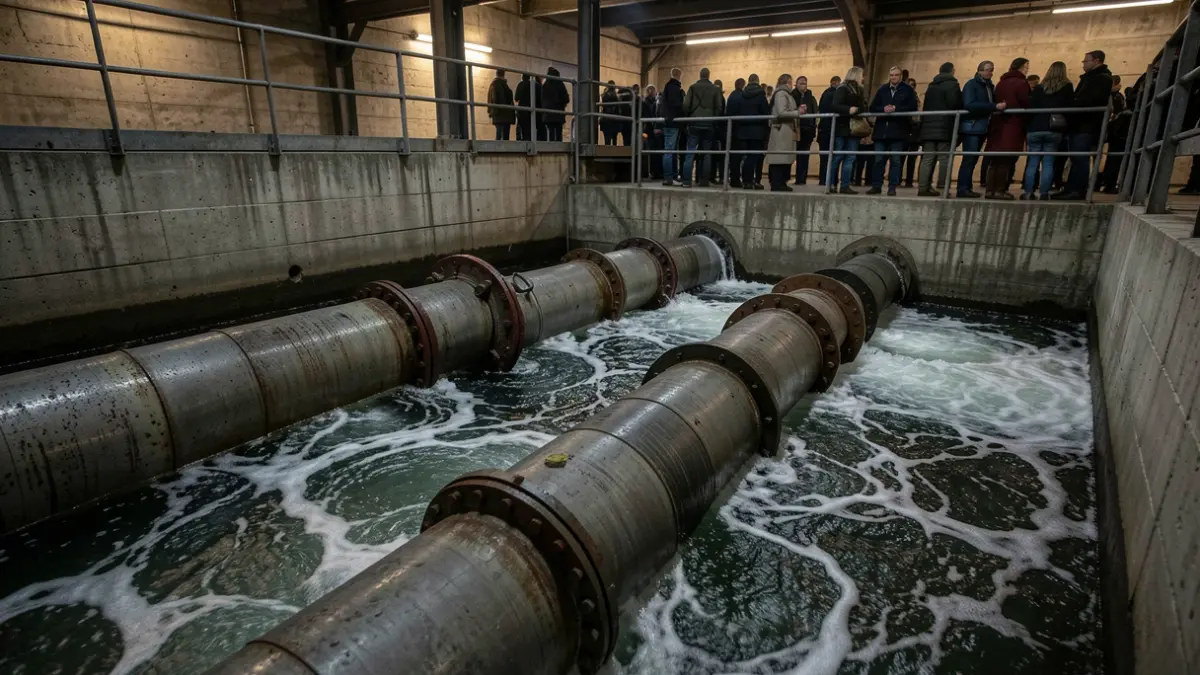
The La Grenouillère basin, a major structure within Bordeaux Métropole's rainwater management system, plays an essential role in protecting the neighborhoods around the Jardin Public and adjacent streets from flood risks during heavy rainfall. Commissioned in 2002 after more than two years of work, it remains largely unknown to the public.
This immense underground reservoir collects rainwater from an area of 170 hectares. With impressive dimensions of 60 meters in diameter and 24 meters in depth, it can store up to 65,000 m³ of water. During significant rainfall events, it acts as a gigantic underground reservoir, temporarily holding excess water volumes to prevent network saturation and reduce flood risks.
Beyond storage, the basin contributes to improving water quality before its release into the natural environment. Its operation relies on a phenomenon called the 'vortex effect': rainwater enters at high speed through an underground collector located on rue Émile Counord, creating a swirling motion that naturally separates pollutants. Heavier particles settle at the bottom, while cleaner water remains on the surface. The clarified water is then discharged into the Garonne River. Pollutant-laden water and settled matter are sent to the Louis Fargue wastewater treatment plant.
Internally, the basin is organized into three concentric zones: a central compartment that receives rainwater and promotes particle settling, an intermediate compartment that stores decanted water as rainfall volume increases, and a pumping compartment that collects the most pollutant-heavy water to send it to the sanitation network.
During heavy rains, the flow rate of the collectors feeding the basin can reach up to 17 m³ of water per second, highlighting its key role in protecting residents and the Garonne River.