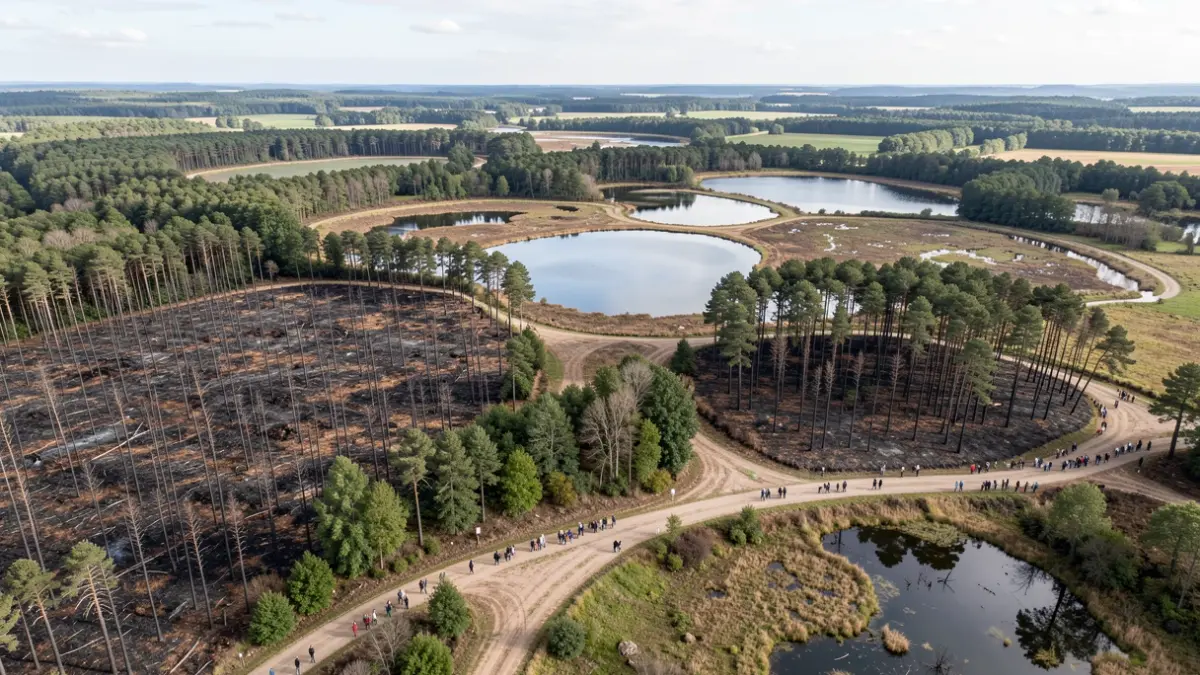
This event aims to raise awareness about ecological transition and biodiversity preservation, particularly in the context of the 2022 fires that affected the region. The Hostens estate, a former converted open-pit mining industrial wasteland, serves as an example of valorizing an exceptional site, designated as Natura 2000.
The site hosts a wide variety of natural habitats, including aquatic meadows, wet heathlands, reed beds, and pine forests. It is a refuge for numerous remarkable species, such as the European pond turtle (cistude d'Europe), the European otter (loutre d'Europe), the whitetip marsh darner (leucorrhine à front blanc), and the slender emerald damselfly (cordulie à corps fin). The flora is also diverse, featuring species like the marsh orchid (epipactis des marais) and the round-leaved sundew (rossolis à feuilles rondes).
To preserve this biodiversity, the Gironde department implements various actions: habitat maintenance, optimization of hydraulic management, control of invasive species, sustainable management of wooded areas, and population monitoring. Following the 2022 fires, reforestation programs with local species and reinforced surveillance measures have been put in place.
The eco-pastoralism initiative, involving local "vaches marines" (marine cows) managed in partnership with the Conservatoire des races d'Aquitaine, contributes to sustainable land management and a low-carbon policy. This project is supported by Banque Populaire Aquitaine Centre Atlantique.
The Hostens estate offers numerous outdoor activities, including hiking trails, wildlife and flora observation, and a leisure center. Workshops and nature outings are organized for various age groups, such as storytelling walks, VTT (mountain bike) discovery tours, collective canoe trips, and slow forest walks to connect with nature.
The Hostens nature center, open in July and August, provides a welcoming space for information and environmental awareness, accessible to all, including people with reduced mobility. The site is open to the public with marked trails and information points.
Access to the estate is facilitated by road (from Bordeaux via D932 and D10, or from Langon via D10), carpooling, public transport (line 504 of the Nouvelle-Aquitaine network), and a cycle path. Free parking is available. Reservations are recommended for certain activities, and visitors should bring essentials (hat, water, suitable shoes).
Strict regulations are in place to preserve the site's quality and visitor safety, including staying on marked trails, not degrading flora, and keeping animals on leashes, with dogs prohibited from beaches and children's play areas. Dog owners are also warned about their pets' sensitivity to cyanobacteria. Visitors are asked to contribute to environmental preservation through responsible conduct.