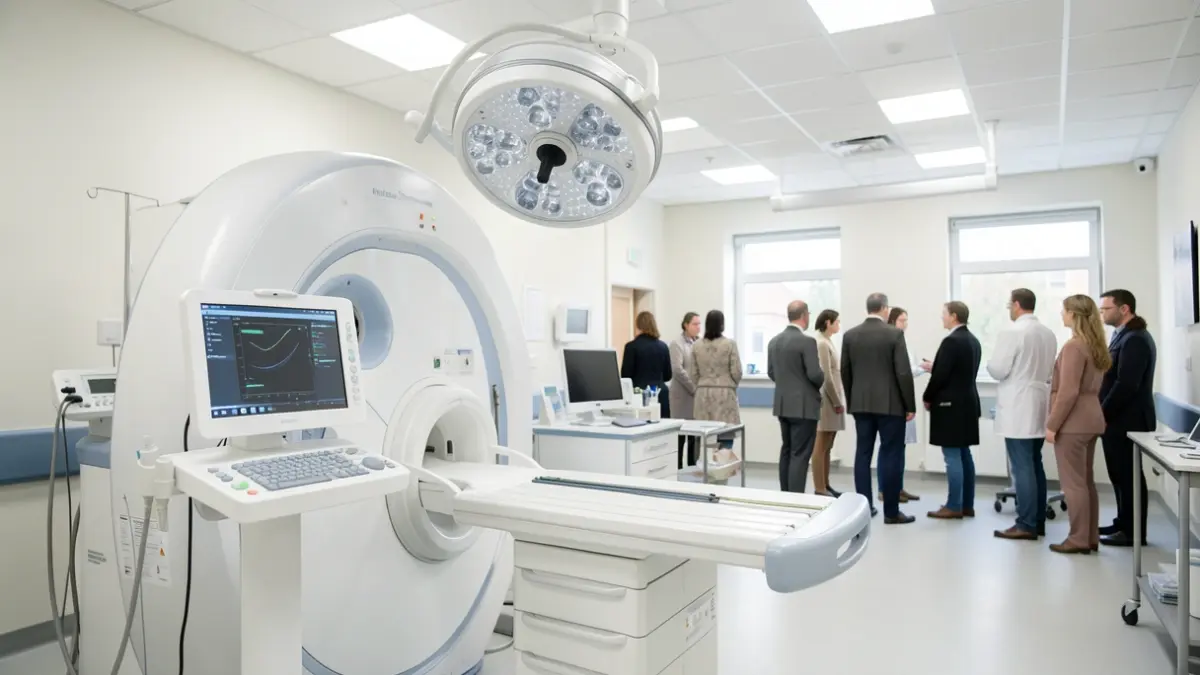
The radiotherapy department at Poitiers University Hospital is taking a new step in its modernization with the recent acquisition of a Varian particle accelerator. A second identical unit is planned for 2027, as part of an ambitious investment plan launched in 2021 and extending until 2030. These new devices will replace aging equipment and maintain a 'mirror machine' configuration, ensuring treatment continuity in case of maintenance or breakdown.
This technological choice supports the department's medical project, focused on developing adaptive radiotherapy. Dr Antoine Berger, head of the department, explains this evolution: 'Traditionally, treatments were designed as a series of identical, pre-planned sessions. Today, radiotherapy is undergoing a major transformation towards an adaptive approach. Treatments must now be rethought as a series of individual sessions, re-evaluated and adapted daily based on the patient's specificities and their condition on that day. The treatment thus becomes a sum of personalized sessions.' This approach requires high-performance IT tools and high-quality imaging, which the new Varian accelerator guarantees.
The Varian accelerator, equipped with the Halcyon® system, combines precision, speed, and ergonomics. It integrates the Hypersight imaging system for rigorous tumor positioning control, a multi-leaf collimator for precise targeting, and an automated interface. The motorized table ensures comfortable patient positioning. Medical physicists Aurélie Sors and Odile Boissonnade highlight the exceptional image quality provided by Hypersight, comparable to CT scans, enabling direct replanning and reducing error risks.
These two Varian accelerators will complement the hybrid technical platform, which already includes two Elekta accelerators. Dr Berger notes that this coexistence, despite involving constraints, was chosen to advance imaging capabilities. The previously acquired Elekta accelerators address major challenges such as breath-hold irradiation for left breast cancers and stereotactic radiotherapy, with 80 to 100 patients treated annually for the latter. The medium-term goal is to unify the tools to simplify processes.
To optimize patient care amidst patient influx, the department is also deploying an onboard portal imaging pre-treatment control solution (EPID) across its four accelerators. This technology transforms the workflow by using the accelerator's energy and integrated detector to validate the treatment plan, offering flexibility and autonomy to the teams. The deployment brings significant benefits for appointment planning and daily machine time optimization.
This modernization project is driven by a multidisciplinary team coordinated by Aurélie Supiot. Key stakeholders include Dr Antoine Berger (radiotherapy department head), Dr Stéphane Guérif (brachytherapy), Christine Barritault (head nurse), Laurent Bonvalet (head of medical physics), Aurélie Sors and Odile Boissonnade (medical physicists), as well as Marie Favre and Fanny Coussot (IT project managers) and Eric Imbert (works programming manager). The general management provides strong support for this project, praising the quality and safety of care offered by these new technologies.
Patient service began on September 9, 2026. The allocated budget is 3,300,000 euros per accelerator, including IT and construction costs. The expansion of the regional oncology center will provide the department with additional space for its offices.