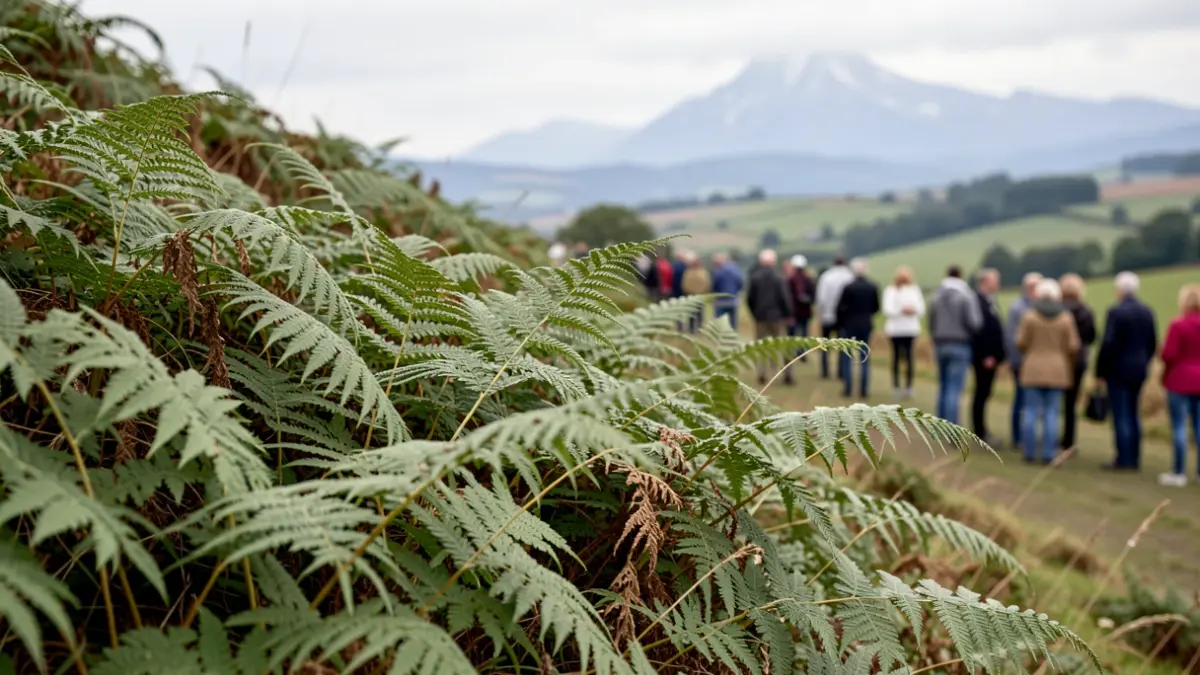
On the communal heathlands, north of the town and on the Ursuya mountain, bracken fern grows abundantly thanks to the mild and humid climate of the Basque Country. Each year, between September and the end of October, farmers cut it, dry it, and then bale it. It is then used as bedding for their sheep and cows, instead of straw. When dry, it absorbs moisture very well.
This practice involves about 330 hectares being mown, producing 900 tonnes of bedding annually, used by some sixty farmers. Each farmer harvests one or more batches allocated by the municipality.
The fern harvest offers several benefits: it allows farmers to buy less straw, often imported from Spain; it keeps the heathlands open and accessible to walkers, hikers, trail runners, and hunters; it reduces fire risk; it promotes grass regrowth, feeding pottoks (local ponies) and livestock; and it maintains a landscape that would otherwise gradually close in.
Until now, the municipality lacked a clear method for assigning an economic value to the fern batches, particularly when allocating a batch to a new farmer. Therefore, it was necessary to re-evaluate all batches using a shared and consistent method.
This summer, Raphaël Perot, a student in the professional degree program "Mountain and Pastoralism," interned at the town hall as part of a partnership with the Chamber of Agriculture of Pyrénées-Atlantiques. He met with 19 farmers to understand their use of fern and define the criteria for a "good" batch. He then updated the map of the batches and developed an evaluation method based on fern height and leaf count, density, harvestable quantity per hectare, batch area, slope, and access. Field measurements were taken for each batch.
The internship is nearing its end, and the field surveys are almost complete. Each batch will soon receive a quality score, providing the municipality with an objective reference for managing its fern resources. The town hall thanked the farmers for their participation in this initiative.