Vals de Saintonge Communauté has successfully completed an ambitious greening project for the courtyard of the La Fraternelle school in Villeneuve la Comtesse. The goal is to improve student comfort, especially during hot periods, while promoting biodiversity and offering new educational opportunities.
Starting in April 2025, a series of participatory workshops allowed children and teachers to co-design the project, envisioning future play and relaxation areas. Prior to this, a technical diagnosis and consultation phase identified uses, constraints, and expectations for a needs-adapted development.
The project was carried out by a collective of landscape architects and project managers, including Collectif Brèche and Alter Bâtir. A significant portion of the work, including the removal of asphalt surfaces and soil preparation, was performed by the community's green space service agents.
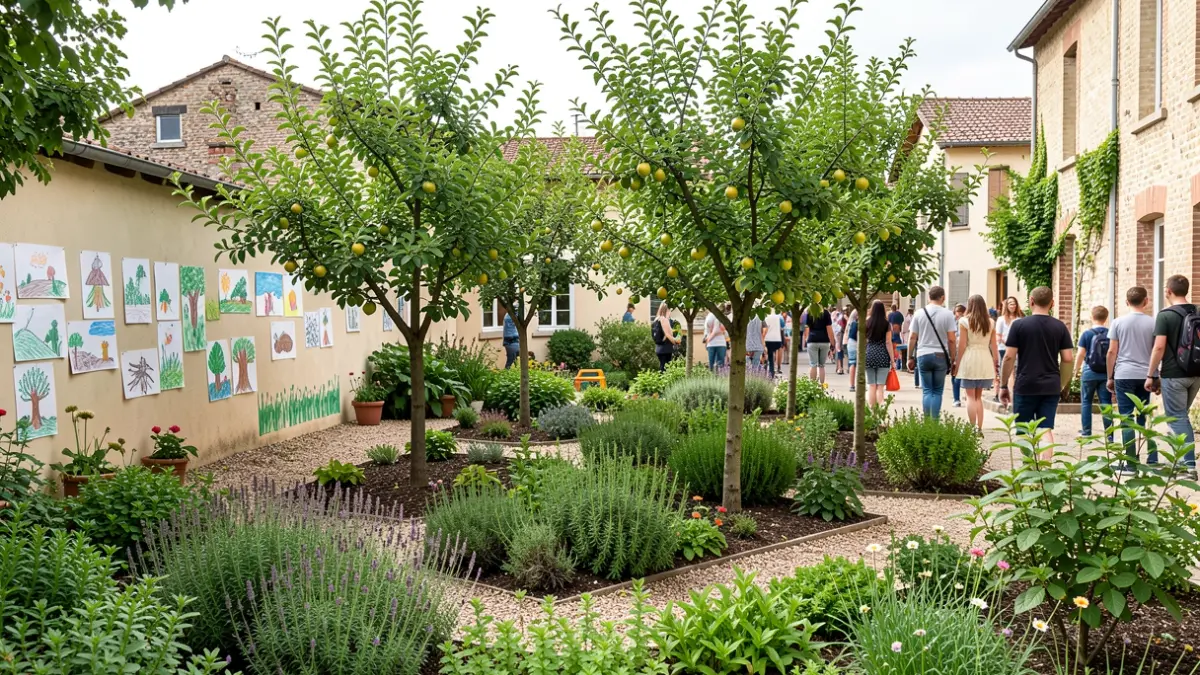
Work began in October 2025 with the removal of some of the asphalt to de-impermeabilize the soil. This process improves rainwater infiltration, limits the urban heat island effect, and cools the courtyard. The greening includes creating shaded areas and diverse spaces for play and rest.
Planting, which started during the winter and continued until spring 2026, features local species adapted to the climate and safe for young children. A small orchard was installed in the kindergarten courtyard, along with drought-resistant aromatic plants like wild thyme and spearmint, serving as educational tools.
The greening also served as a pedagogical support. Students participated in cutting and sowing workshops, nature walks, and classroom sessions, led by Collectif Brèche and Nature Santé & Territoire. Information sessions were also offered to parents, and participatory planting events were organized.
In an eco-responsible approach, play furniture was made from recycled materials, partly through a partnership with En Réemploi. Some of the removed asphalt was reused on-site for seating and borders, aligning the project with principles of sobriety and circular economy.
A few weeks after project completion, initial feedback is encouraging. Teachers noted a less stifling courtyard during the hot spells in May. Children appear calmer, conflicts have decreased, and new forms of play are emerging. Children actively participate in maintenance, such as watering plants.